
A team I worked with recently looked healthy. They had capability, clarity, and a shared sense of commitment.
Yet innovation had stalled.
Competitors were moving faster, testing new ideas, getting them to market and gradually pulling customers away. Inside the team, conversations stayed safe and predictable.
People rarely pushed thinking further or explored possibilities beyond what was already known.
This idea is explored further in: How Deliberate Teams Build Trust And High-Performing Results.
When Capability Isn’t The Problem
As we spent more time together, what was really happening became clearer.
It was not a lack of ideas that was holding this team back, it was a reluctance to express them.
There was an unspoken expectation that ideas needed to be fully formed, well thought through, and close to perfect before they were shared. Anything less felt risky.
When I asked what might help unlock the next level of performance, one person said, “I need to know it’s okay to be wrong sometimes.”
That comment landed.
It pointed to something deeper than time pressure or workload.
The real constraint was a culture shaped by perfectionistic tendencies, where getting it right mattered more than exploring what might be possible.
In teams like this, innovation struggles to emerge.
- People hold back early ideas.
- They refine privately instead of building collectively.
- They avoid putting forward something that might be challenged or dismissed.
Over time, this creates a kind of stagnation where everyone is capable, but no one is stretching.
A related perspective can be found in: Why Collaboration Breaks Down (And What Deliberate Leaders Do Differently).
How Psychological Safety Drives Innovation In Teams
Psychological safety is often spoken about, yet it is easy to underestimate how directly it connects to innovation.
Innovation rarely emerges when people feel pressure to be right all the time.
It is not about making things comfortable for the sake of it. It is about creating conditions where thinking can be shared in its early, imperfect stages, where ideas can be shaped through conversation rather than protected in isolation.
When people feel that sense of safety, they start to contribute sooner.
- They question assumptions instead of accepting them.
- They are more willing to test, learn, and adjust.
- They raise concerns before they become problems.
- They collaborate more openly rather than working in parallel.
With this team, the shift began with something simple but deliberate.
Before making decisions, they made space for alternative views and unfinished thinking.
They are still getting used to this.
People still hesitate and choose their words carefully.
Over time, it will become easier to speak up without having everything perfectly formed.
Eventually, it will become a strength of the team rather than a point of discomfort.
How Leaders Create Safer Team Cultures
What is changing is not how hard people work, but how willing they are to think out loud, challenge each other, and take small risks in front of their peers.
Innovation is beginning to re-emerge because the expectation of perfection has been called out.
This kind of culture emerges through consistent leadership behaviours.
Leaders who stay curious for longer, who ask what they might be missing, and who respond constructively when ideas are raised, even when those ideas are not yet fully developed.
In many cases, this is where leadership coaching can help teams build stronger trust, communication, and performance habits over time.
Leaders need to demonstrate vulnerability to create a sense of safety that lifts performance.
The strongest teams are not those that eliminate fear entirely.
They are the ones where people feel supported enough to move forward despite it, knowing that progress matters more than perfection.
Frequently Asked Questions
What Is Psychological Safety In Teams?
Psychological safety is the belief that people can speak openly, share ideas, ask questions, and challenge thinking without fear of embarrassment or punishment.
Why Is Psychological Safety Important For Innovation?
Innovation depends on people sharing incomplete ideas, testing assumptions, and learning through discussion. Without psychological safety, teams often avoid risk and default to safe thinking.
How Do Leaders Improve Psychological Safety?
Leaders improve psychological safety by responding constructively to ideas, encouraging different perspectives, admitting mistakes, and staying curious during discussions.
Can High-Performing Teams Still Lack Psychological Safety?
Yes. Teams can appear capable and aligned while still avoiding difficult conversations, withholding ideas, or hesitating to challenge assumptions.
What Are Signs Of Low Psychological Safety?
Common signs include limited participation, over-prepared ideas, avoidance of disagreement, low innovation, and hesitation to raise concerns early.
If this sounds familiar, your team may not have a capability problem — it may have a culture pattern that is limiting performance.
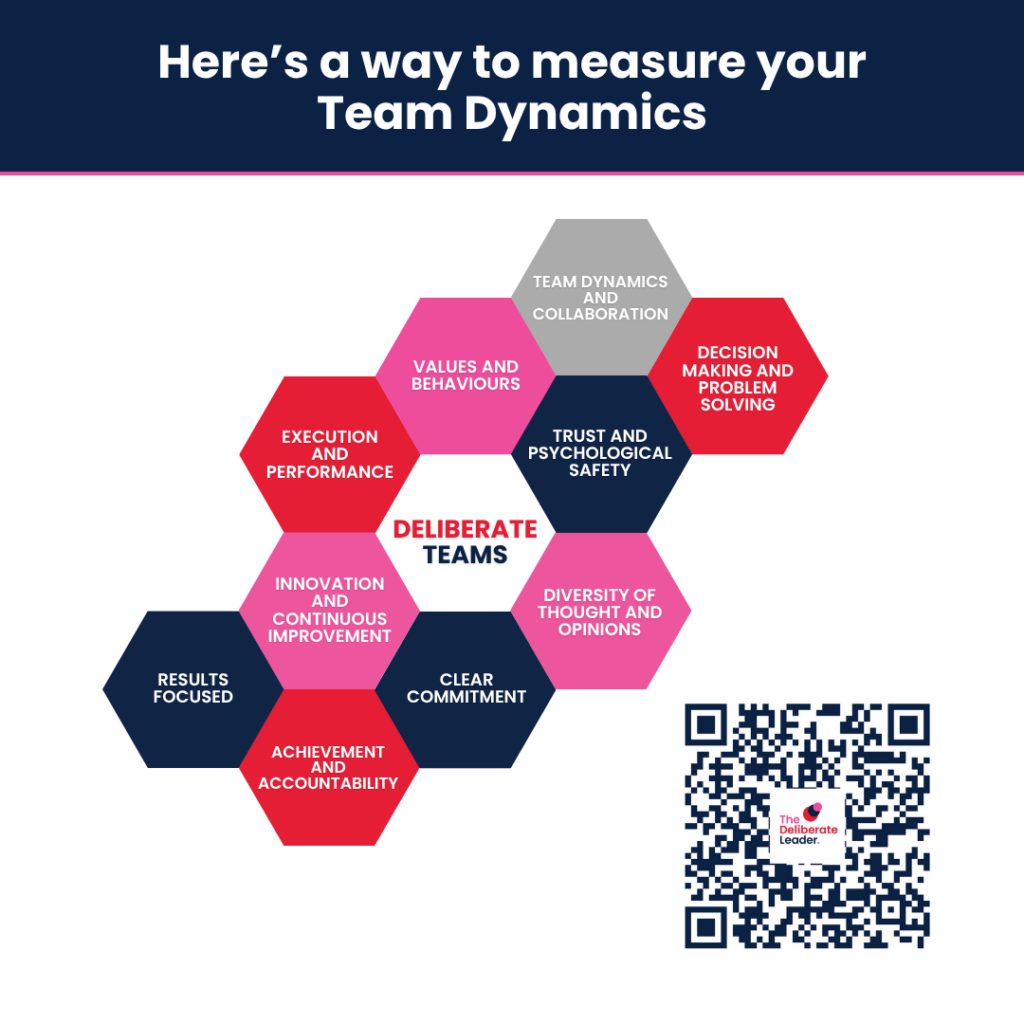
Our Deliberate Team Health Diagnostic helps uncover the hidden dynamics impacting innovation, trust, communication, and results. Take the diagnostic or book a conversation to explore where your next breakthrough could come from.