
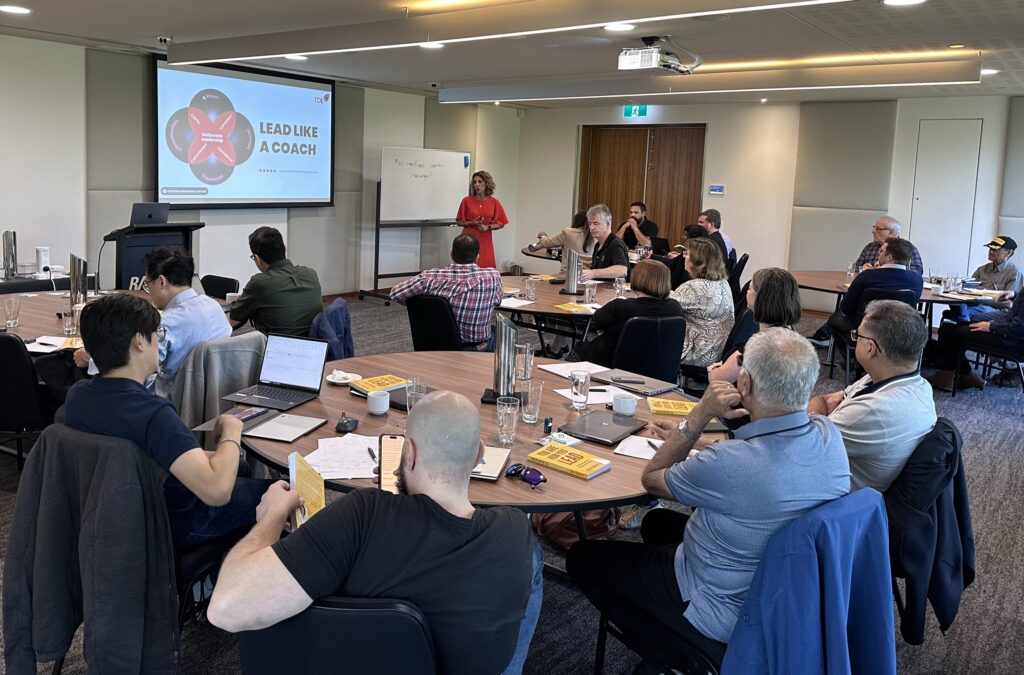
Team coaching plays a critical role in improving how teams perform, align, and deliver results. It is not a soft leadership intervention, but a structured approach that strengthens decision-making, accountability, and execution.
Rather than focusing on individuals, team coaching improves how teams work together. When applied effectively, it leads to clearer communication, stronger alignment, and more consistent performance.
The value lies not in motivation, but in behavioural clarity. Teams that are coached effectively do not just collaborate better. They produce more consistent, measurable outcomes.
What Is Team Coaching and Why It Matters
Team coaching is a structured approach that improves how teams collaborate, make decisions, and deliver results. It focuses on collective behaviour rather than individual performance.
Key benefits of team coaching include:
- Stronger alignment across team members
- Clearer accountability and ownership
- Improved communication and decision-making
- More consistent execution and performance
- Greater ability to adapt under pressure
When teams are coached effectively, they become more aligned, more accountable, and more capable of delivering sustained results.
How Team Coaching Improves Team Performance Systems
Defining Team Coaching Beyond Individual Development
Team coaching is a structured process that improves how a group functions as a unit. It focuses on collective patterns, not individual performance gaps. The goal is to strengthen how the team thinks, communicates, and delivers together.
Unlike mentoring or training, team coaching operates inside real work. It observes decision-making, surfaces assumptions, and reshapes interaction habits. This creates alignment that is both practical and immediate.
Within the broader leadership architecture of high-performing teams that build trust and results, team coaching acts as a mechanism that reinforces behavioural consistency. It does not replace leadership. It sharpens how leadership shows up across the team.
Team coaching improves performance by changing collective behaviour, not individual capability.
The Performance Shifts Team Coaching Enables
When applied with discipline, team coaching produces observable shifts in how teams operate:
- Conversations move from polite agreement to constructive challenge
- Accountability shifts from leader-owned to team-owned
- Decisions become clearer, faster, and more aligned
- Execution becomes more consistent across members
- Feedback becomes normalised, not avoided
These shifts are not theoretical. They directly influence delivery timelines, quality of output, and the ability to respond under pressure.
Without these behavioural adjustments, teams often remain technically capable but operationally inconsistent.
Common Leadership Mistakes That Weaken Team Coaching Impact
Treating Coaching As An Intervention, Not A System
A frequent mistake is positioning team coaching as a one-off initiative. Leaders may introduce sessions during periods of underperformance, expecting quick behavioural change. This approach rarely works.
Team coaching is not a fix. It is a system that requires continuity and reinforcement. When applied inconsistently, it creates awareness without embedding change.
Another common error is over-facilitating. Leaders or external coaches may dominate discussions, reducing team ownership. This limits the development of internal accountability.
To avoid these issues, leaders should focus on three disciplines:
- Embed coaching into regular team rhythms
- Shift from directing to observing and guiding
- Hold the team accountable for behavioural commitments
When these disciplines are missing, coaching becomes performative rather than effective.
Ignoring Behavioural Signals In Favour Of Outcomes
Leaders often prioritise results over behaviour, assuming outcomes validate team effectiveness. This creates a blind spot.
Teams may achieve short-term success while reinforcing unhealthy patterns such as avoidance, over-reliance on key individuals, or unclear ownership. Over time, these patterns erode performance stability.
Team coaching requires attention to how results are achieved, not just what is achieved. Behavioural signals such as silence in meetings, repeated misalignment, or unclear follow-through are critical indicators.
Sustainable performance depends on reinforcing behaviours, not just achieving outcomes.
Organisationally, ignoring these signals leads to:
- Inconsistent delivery across teams
- Increased dependency on high performers
- Reduced adaptability during change
- Hidden conflict that surfaces under pressure
A structured team coaching approach surfaces and corrects these patterns early.
How To Apply Team Coaching For Better Performance
Team coaching improves performance by strengthening how teams communicate, make decisions, and hold each other accountable.
Translating Coaching Into Everyday Team Behaviour
Effective team coaching is visible in daily interactions, not just structured sessions. It shapes how teams run meetings, make decisions, and handle accountability.
Leaders can embed coaching through simple, repeatable practices:
- Clarify decision ownership at the end of every discussion
- Encourage challenge before agreement is reached
- Reflect briefly on what worked and what did not after key milestones
These practices reinforce behavioural consistency without adding complexity.
One practical approach is to use guided reflection questions during team interactions. This builds awareness while maintaining focus on delivery.
For example, after a project phase, teams can ask:
- Where did we align quickly, and why?
- Where did we hesitate or avoid challenge?
- What behaviour do we need to adjust next time?
This keeps coaching grounded in real work rather than abstract discussion.
Strengthening Accountability Through External Perspective
In some cases, internal leadership may struggle to maintain objectivity. Patterns become normalised, and behavioural gaps are overlooked.
This is where structured support, such as leadership team coaching, can provide value. An external perspective helps identify blind spots and reinforce disciplined practice without disrupting team ownership.
The role of external coaching is not to lead the team but to sharpen how the team leads itself. It introduces clarity, not dependency.
Over time, the goal is for the team to internalise coaching behaviours. This creates self-regulating teams that maintain performance without constant intervention.
The organisational benefit is significant. Teams that adopt coaching as a habit become more resilient, more aligned, and more capable of sustaining results under pressure.
Conclusion
Team coaching is not an optional leadership tool. It is a practical method for strengthening how teams perform together. By focusing on collective behaviour, it creates alignment, accountability, and consistency in execution.
When applied with discipline, it moves teams beyond capability into reliable performance.
Frequently Asked Questions
Q: What Is Team Coaching?
A: Team coaching is a structured approach that improves how a group works together by strengthening communication, alignment, and shared accountability.
Q: How Does Team Coaching Improve Performance?
A: It improves performance by aligning team behaviour, clarifying decisions, and reinforcing accountability, leading to more consistent execution.
Q: What Is the Difference Between Team Coaching and Individual Coaching?
A: Individual coaching focuses on personal development, while team coaching improves how the group collaborates and delivers results together.
Q: When Should Organisations Use Team Coaching?
A: Team coaching is most effective during growth, change, or when teams need stronger alignment and performance consistency.
Q: Does Team Coaching Improve Accountability?
A: Yes. It shifts accountability from the leader to the team, creating shared ownership and more consistent follow-through.
Where is your team avoiding necessary challenges that are limiting performance?
If you want to strengthen how your team performs together, explore how structured coaching can support your goals:
👉 Reach out to begin the conversation
Sources:Hackman, J. R. (2002). Leading Teams: Setting the Stage for Great Performances
Clutterbuck, D. (2019). Coaching the Team at Work
Hawkins, P. (2017). Leadership Team Coaching