

Australian leadership teams have come a long way, but not nearly far enough when it comes to women’s leadership in Australia. Women still hold just over one in five CEO roles, and globally just 23% of board seats are held by women. Progress has stalled. And while the conversation around gender equity has traditionally focused on fairness, the case today is just as much about economics, performance, and shared prosperity.
In a time of soaring living costs and growing business complexity, we can’t afford to leave capability on the bench, A challenge we see regularly at The Deliberate Leader. Gender-balanced leadership is no longer a nice-to-have; it’s a strategic advantage. When organisations invest deliberately in women’s leadership development, the benefits extend beyond equity to productivity, resilience, and economic stability.
The Cost-Of-Living Connection
The economic impact of gender inequality is no longer theoretical says. It’s measurable, and it affects us all.
- The gender pay gap means women working full-time earn $246 less per week than men.
- That adds up to nearly $13,000 a year, money that could support household budgets for rent, food, or childcare.
- The broader economy takes a hit too. Treasury estimates $51.8 billion in lost GDP annually due to the gender pay gap.
Meanwhile, mortgage interest charges jumped 2.6% in one quarter, and everyday costs continue to rise. Closing the leadership gap offers one of the most underused levers to drive income growth, boost productivity, and support household resilience.
The Talent Pipeline Isn’t Broken – But It’s Bottlenecked
Workforce participation is strong. Around 62.9% of Australian women are now active in the labour market. Yet leadership representation continues to lag. At mid-career, momentum stalls, with women globally holding just 33.5% of senior roles, a figure that has flatlined for three years.
This isn’t about capability. It’s about structure, systems, and access to opportunity.
Organisations that embed gender-balanced leadership into strategy, not just rhetoric — are already seeing what’s possible.
- Commonwealth Bank now has 44.9% women in Executive Manager roles, supported by balanced shortlists and transparent talent dashboards.
- BHP lifted its female workforce from 17% to 40% by tying leader incentives to inclusion and redesigning frontline rosters.
- Westpac backed over 1,000 women-led businesses through a $1 billion investment fund.
These outcomes aren’t accidental. They’re the result of focused, business-minded action.
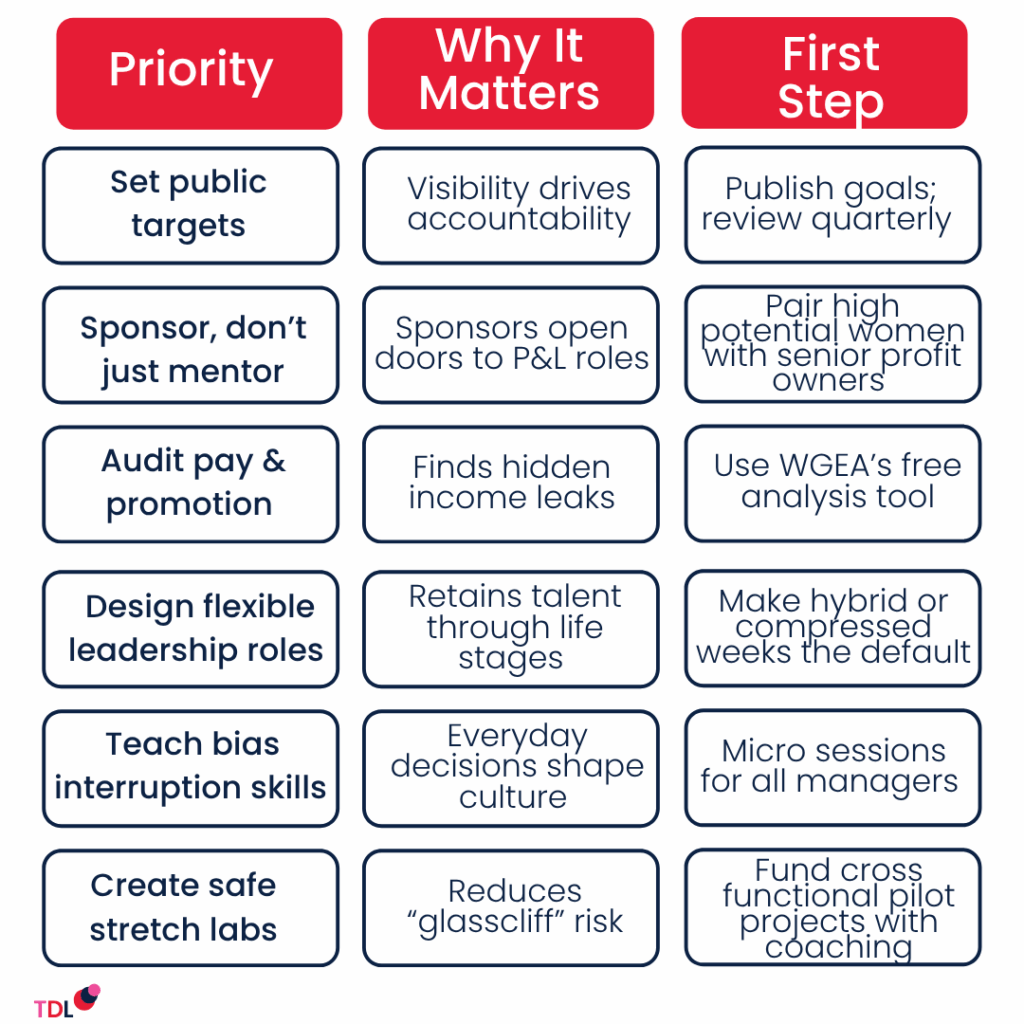
Beyond The Pipeline: Strategic Moves That Drive Progress
No matter your sector or size, moving beyond the pipeline requires intentional choices. Organisations that make progress do more than mentor. They sponsor talent, design inclusive systems, and hold leaders accountable for outcomes.
This shift requires seeing leadership capability as a system, not a one-off initiative, an approach embedded across our broader leadership development programs.
Why This Matters Right Now
The case for advancing women in leadership isn’t a long-term aspiration. It’s a response to today’s pressures and a pathway forward.
- Household relief. Closing the weekly earnings gap would inject nearly $13,000 into the average woman’s wallet each year — real money for rising rents, school fees, and essentials.
- Talent crunch. An ageing workforce means Australia cannot afford to bench half its leadership potential.
- Investor and regulatory pressure. Pay-gap transparency and scrutiny from regulators and superannuation funds are placing laggards on notice.
- Innovation imperative. Diverse leadership teams solve complex problems faster, critical as AI, climate, and geopolitical disruption reshape markets.
The Takeaway
“Fixing the pipeline” is yesterday’s mantra. Today’s challenge is building leadership systems that actively retain, sponsor, and elevate women into roles where strategic and capital decisions are made.
Organisations that treat women’s leadership development as a core business strategy, not a side initiative, will see stronger balance sheets, more resilient cultures, and a meaningful contribution to easing Australia’s cost-of-living crunch.
This is what it means to move beyond the pipeline.
Frequently Asked Questions
Why Is Women’s Leadership Important To Australia’s Economy?
Women’s leadership improves productivity, decision quality, and workforce participation, directly supporting economic growth and household resilience.
What Is Holding Women Back From Senior Leadership Roles?
Structural barriers, lack of sponsorship, and limited access to opportunity often stall progression, not a lack of capability or ambition.
How Can Organisations Move Beyond The Leadership Pipeline?
By embedding accountability, sponsorship, and inclusive systems that support progression into senior decision-making roles.
**Footnotes:
- Office for Women / WGEA, Women in Leadership Statistics.
- Deloitte, Women in the Boardroom Report 2024.
- McKinsey & Company, Diversity Wins: How Inclusion Matters (2020).
- Australian Bureau of Statistics, Full-time gender pay gap figures (Nov 2024).
- Australian Treasury, Media release on economic cost of gender pay gap (Feb 2024).
- ABS, Selected Living Cost Indexes, June 2024.
- Grant Thornton, Women in Business Global Survey 2024.
- Commonwealth Bank, FY2024 Diversity Metrics.
- BHP, Inclusion & Diversity Update (April 2025).
- Westpac, Women in Business Fund Expansion (March 2025).
Want to Hear from the Leaders Doing It Right?
Join us on 4 August for a high-impact virtual panel where leaders share what’s actually working — the strategies, shifts, and stories behind real change.
Because leadership shouldn’t be limited by barriers. And progress doesn’t happen by accident — it happens by design.
👉🏼 Save your seat now and be part of what’s next.