
Collaboration is one of those words that sounds good in strategy documents but feels very different in practice.
Most leaders I work with don’t have a lack of effort. They have a lack of aligned collaboration.
And the signs are everywhere.
-
Meetings go in circles.
-
Decisions are delayed or revisited.
-
People leave unclear – or worse, disengaged.
-
Conversations stay surface-level because the real issues feel too hard or unsafe to raise.
-
Work happens in silos, information is held, and energy is spent protecting territory instead of progressing outcomes.
On the surface, everyone is busy. Underneath, there’s little impact.
This is the real business problem: collaboration isn’t absent – it’s ineffective.
The Hidden Barriers to Collaboration
What gets in the way isn’t usually capability. It’s what sits beneath the behaviour.
When collaboration is missing, you’ll often see:
-
Blurred roles and responsibilities – people either step on each other’s toes or stay in their lane when they shouldn’t
-
Avoided conflict – tension builds because differences aren’t worked through
-
Low trust – feedback is filtered or doesn’t happen at all
-
Disengagement – missed deadlines, low energy, quiet resistance
These aren’t random issues. They are signals.
Signals that your team is stuck in patterns that protect comfort over progress.
Why This Matters More Than You Think
The cost of poor collaboration isn’t just frustration – it’s performance.
Research shows that effective collaboration can drive:
-
Higher productivity
-
Increased innovation
-
Greater profitability
-
Stronger engagement and lower fatigue
Yet many teams unintentionally operate in ways that actively undermine it.
Not All Collaboration Is Equal
One of the biggest mistakes leaders make is assuming more collaboration = better outcomes.
It doesn’t.
There are actually four distinct collaboration patterns:
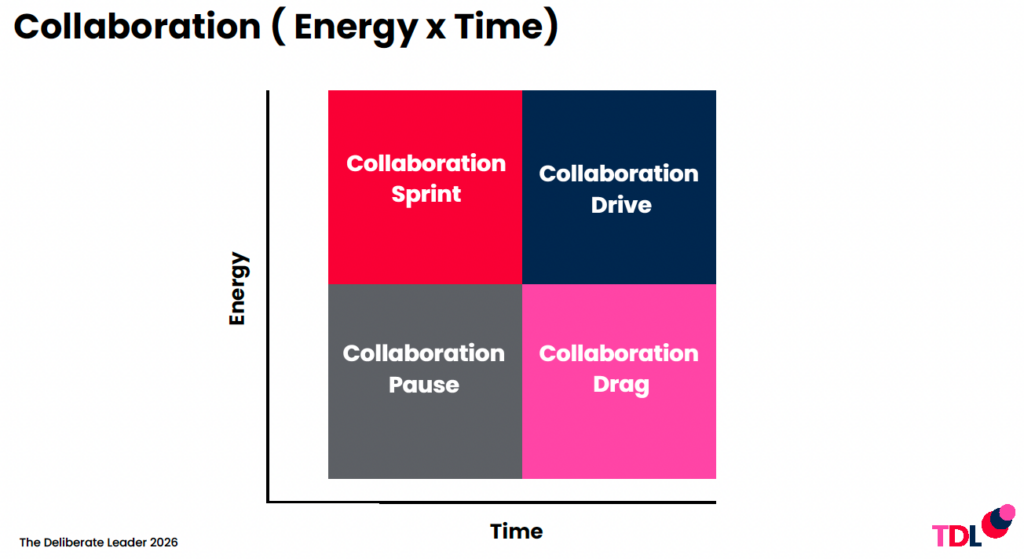
- Collaboration Sprint (High Energy / Short Time)
Fast, focused, and useful for solving immediate issues.
But move too quickly, and you risk missing key perspectives. - Collaboration Drive (High Energy / Long Time)
This is where high-performing teams operate.
Clear roles, shared outcomes, sustained energy, and intentional communication. - Collaboration Pause (Low Energy / Short Time)
Sometimes necessary – but often disguised avoidance.
What isn’t addressed now will come back, usually bigger. - Collaboration Drag (Low Energy / Long Time)
The most costly state.
Slow progress, unclear ownership, and meetings without momentum. Trust erodes. People disengage.
Most teams don’t choose these states consciously. They drift into them.
The Shift to Deliberate Collaboration
Deliberate leaders don’t leave collaboration to chance. They design for it.
That means asking better questions:
- Are we clear on roles and responsibilities?
- Are we having the conversations we’re avoiding?
- Is our collaboration energising or draining the team?
- Are we aligned on what matters most?
And critically:
- Where are we sitting right now – Sprint, Drive, Pause, or Drag?
Because you can’t shift what you don’t name.
Where to Start
If collaboration feels hard in your team right now, don’t start by adding more meetings.
Start here instead:
- Create clarity – on priorities, roles, and outcomes
- Lean into tension – not away from it
- Make ownership visible – who is doing what, by when
- Focus on energy – collaboration should create momentum, not drain it
Collaboration isn’t about getting along.
It’s about working through what matters – together – so you can actually move forward.
That requires intention.
And that’s the difference between reactive teams and deliberate leadership.